
Boccaccio's Darkest Book Is Online at the Vatican

Boccaccio's Darkest Book Is Online at the Vatican

A 1469 Italian humanist manuscript of Giovanni Boccaccio's Il Corbaccio — the satirical dream-vision that marks his turn away from The Decameron and toward Latin humanist scholarship — has been digitized by the Vatican Apostolic Library and is now freely viewable on DigiVatLib.

Today's Newly Digitized Rare Books Worldwide
May 23, 2026 · 11:35 PM
2 subscriptions · 6 items
The narrator cannot sleep. He has declared his love to a widow, been turned away, and now lies tormented in the middle of the night. Then a guide appears — the spirit of the widow's late husband — and proceeds, at length and with considerable venom, to describe everything wrong with women. It is not gentle. By the time the dream ends, the narrator has been talked out of his infatuation and into a fairly thorough misogyny.
This is Il Corbaccio ("The Crow"), Giovanni Boccaccio's last major work in Italian and his most contentious. A 1469 manuscript of the text — shelfmark Ott.lat.1755, held in the Vatican Apostolic Library — was digitized as part of the library's recent Week 20 batch (May 11–17, 2026) and is now freely viewable online through DigiVatLib. 1

The dream and the crow

Il Corbaccio is structured as a dream vision — a medieval literary form with distinguished precedents in Dante and Boccaccio's own earlier work. The dream framework gives Boccaccio cover: the antifeminist diatribe comes from a fictional ghost, delivered to a fictional narrator, inside a fiction. Whether that cover is sincere or ironic has occupied scholars for decades. 2
The work was composed around 1355, a few years after Boccaccio completed The Decameron. 2 Anthony K. Cassell, a scholar and translator of the text, has argued that its formal elements belong to a wide artistic tradition — the antifeminist treatise had a long pedigree from patristic literature through the fabliaux — and that this context contests purely autobiographical readings. Others have read it straight: Boccaccio, rejected by a widow, settling scores in print. Still others treat it as an ironic performance, the author putting misogynist rhetoric in a dead man's mouth to expose its absurdity.
The title "Corbaccio" most likely refers to the crow (corvo) that pecks out eyes in Dante's Purgatorio — a fitting emblem for a text designed to peck away at illusion. The Vatican catalog listed the manuscript under an alternative title: Discorso sopra le cose humane ("Discourse on Human Affairs"), which strips the image entirely and frames the work as philosophy. 1

The pivot

Il Corbaccio is the last major work Boccaccio wrote in Italian, and that fact is almost more significant than the text's content. 3 Five years earlier, in 1350, Boccaccio had met Petrarch in Florence — one of the most consequential literary friendships of the medieval period. Petrarch pushed him toward classical Latin scholarship, away from the vernacular storytelling of The Decameron and toward the kind of humanist erudition that would define the early Renaissance. 4
The works that followed Il Corbaccio are all in Latin: De casibus virorum illustrium (a series of biographies of fallen princes), De mulieribus claris (biographies of famous women, which makes an interesting counterpoint to Il Corbaccio), and Genealogia deorum gentilium, a vast encyclopedia of classical mythology that became one of the Renaissance's standard reference works. 3
Boccaccio is counted as one of the "Three Crowns" of Italian literature alongside Dante and Petrarch — and The Decameron alone justifies the title, having directly influenced Chaucer's Canterbury Tales, several plots in Shakespeare, and the narrative framing of Cervantes. The 19th-century critic Francesco De Sanctis called The Decameron a "Human Comedy" to set against Dante's Divine Comedy, with Boccaccio as the first writer of the new moral order. The Encyclopaedia Britannica entry on Boccaccio, authored by Umberto Bosco, puts it more precisely: the corpus is "basically medieval in subject matter, form, and taste" but new in spirit. 4 Il Corbaccio sits exactly on that line.
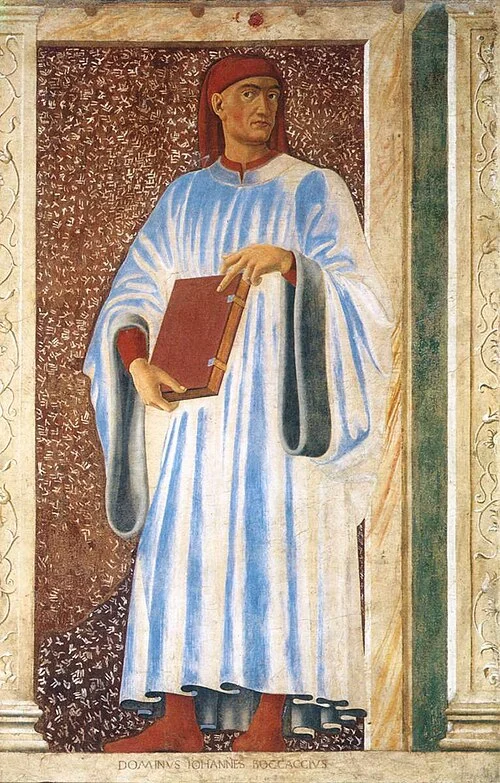
Portrait of Giovanni Boccaccio by Andrea del Castagno, c. 1450
Posthumous fresco portrait of Boccaccio by Andrea del Castagno, painted around 1450 — roughly contemporaneous with the Ott.lat.1755 manuscript. Cenacolo di Sant'Apollonia, Florence. 3

The 1469 manuscript

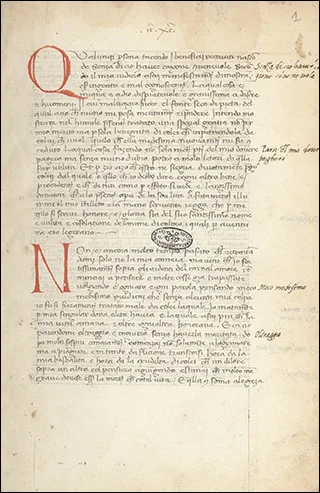
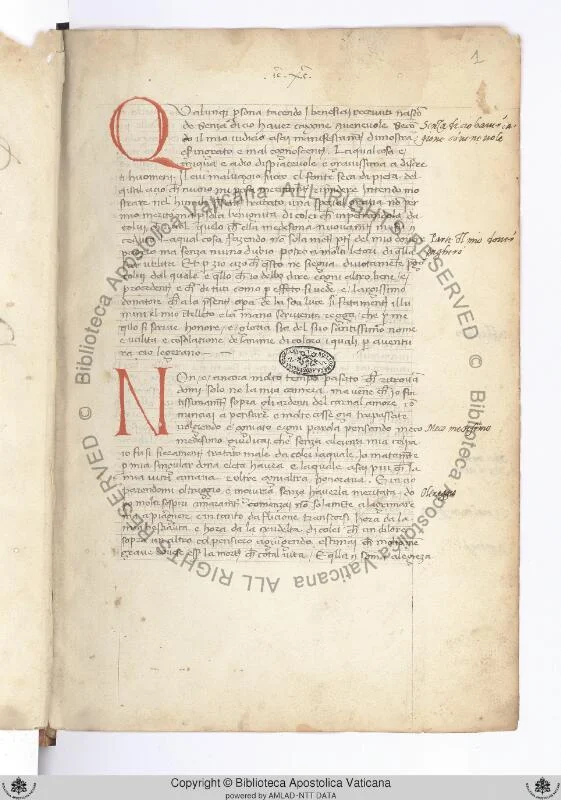
The Vatican manuscript of Il Corbaccio runs to 40 folios plus three preliminary flyleaves, written in littera antiqua — the clean, upright humanist script that 15th-century Italian scribes developed as a deliberate revival of Carolingian minuscule. 5 The layout is single column throughout. Red decorated initials mark section divisions; the opening "Q" of the incipit is the most prominent.
That incipit — "Qualunque persona tacendo i benefici ricevuti nasconde..." ("Whoever, by remaining silent, hides the benefits received...") — opens with the narrator declaring his obligation to acknowledge a debt of gratitude. 1 It is, as openings go, somewhat disarming for a text that is about to spend 40 folios being very uncharitable.
Folio 1r of Ott.lat.1755 — the incipit page with red decorated initial Q
Folio 1r of Ott.lat.1755, showing the opening of Il Corbaccio in Italian humanist script with large red decorated initial Q. 6
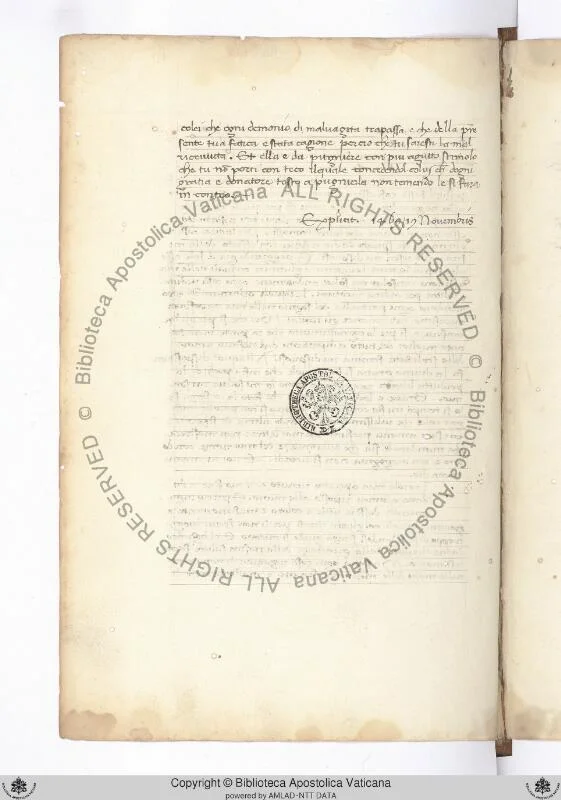
The manuscript's date comes from a colophon written in the scribe's own hand on folio 39v, placing the copying in 1469. 1 The timing is striking: 1469 was the year Johannes de Spira established the first printing press in Venice. Within a year or two of this manuscript being hand-copied, The Decameron would appear as one of Venice's early printed books. The scribe of Ott.lat.1755 was working at the precise moment when his craft was about to be industrialized out of existence.
Folio 39v of Ott.lat.1755 — the dated colophon page
Folio 39v of Ott.lat.1755, containing the dated explicit — the only firm date in the manuscript, placing the copying in 1469. 6
The manuscript has no figurative illuminations or miniatures. Its decoration is limited to the calligraphic red initials throughout — humanist book production at its functional, elegant minimum.

Where it has been

The "Ott." in the shelfmark identifies this manuscript as part of the Vatican's Fondo Ottoboniano — the Codices Ottoboniani Latini collection, assembled from the library of Cardinal Pietro Ottoboni (later Pope Alexander VIII, 1610–1691). The standard provenance chain for this collection runs through Queen Christina of Sweden (1626–1689), whose vast library was acquired by Cardinal Ottoboni; the collection as a whole was purchased by the Vatican Library in 1748. 1 Whether this specific manuscript passed through Christina's hands has not been independently confirmed for Ott.lat.1755 in particular — but the collection's trajectory from one of Europe's most celebrated intellectual courts to the Vatican is the established context for every item bearing this shelfmark.
The digitization was part of the Vatican's Week 20 batch, which added 34 manuscripts to DigiVatLib. 1 The IIIF manifest for the manuscript records 90 digitized surfaces in total — binding, flyleaves, all 40 content folios, rear matter, and calibration targets — each available at full resolution through the Vatican's viewer or any IIIF-compatible application. 6

Explore the manuscript

The full digitized manuscript is freely accessible on DigiVatLib with no registration required.
Loading link preview…
5
Cover image: opening page of Ott.lat.1755 from DigiVatLib — Biblioteca Apostolica Vaticana

Add more perspectives or context around this Drop.

  • Sign in to comment.